The Federal Reserve’s latest policy move was expected to calm financial markets. Instead, it set off one of the sharpest intraday reversals the crypto sector has seen this quarter.
After delivering a widely anticipated 25-basis-point rate cut, the Fed signaled a slower path ahead, and that shift in tone was enough to send major digital assets back. What looked like a supportive macro backdrop quickly turned into a trigger for risk-off positioning across Bitcoin, Ethereum, and the broader altcoin market.
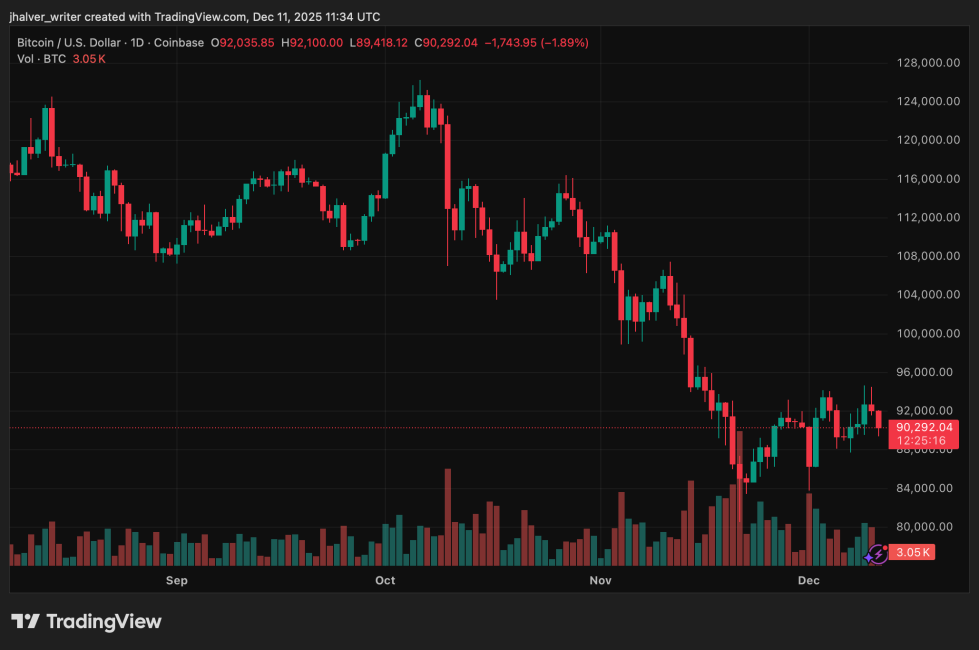
BTC's price trends to the downside on the daily chart. Source: BTCUSD on Tradingview
Mixed Fed Messaging Fuels Market Confusion
The Federal Open Market Committee lowered the federal funds rate to a 3.5%–3.75% range, marking its third cut of the year. But internal disagreement, including two members opposing any cut and one pushing for a larger one, highlighted uncertainty within the Fed itself.
Chair Jerome Powell supported that ambiguity by saying the central bank remains “well-positioned to wait,” a phrase traders interpreted as a possible pause in January.
Economic projections added more caution. Officials expect only one additional cut in 2026, far fewer than markets had priced in. While the Fed also announced $40 billion in monthly Treasury bill purchases, seen by some as “QE-lite”, investors viewed the move more as an attempt to steady liquidity in a slowing economy.
The dollar weakened sharply after Powell ruled out a 2026 rate hike, but expectations for near-term easing also faded. Futures markets quickly shifted, showing a higher probability of no change in January.
Crypto Markets Reverse as Liquidity Concerns Rise
The crypto market reacted within minutes of the Fed’s press conference. Total market capitalization fell roughly 3% over the next 24 hours, with Bitcoin sliding below $90,000 after briefly testing highs near $94,000 earlier in the week.
Ethereum lost more than 3%, and altcoins posted deeper declines as investors moved toward lower-risk exposure.
Rising liquidations added pressure. More than $1 billion in leveraged positions were wiped out in the broader market over a 24-hour period, while Bitcoin dominance climbed to around 58%, reflecting a shift away from speculative assets.
Technical signals also turned bearish, with total crypto market cap slipping below the 200-day EMA and several major tokens failing to reclaim key resistance levels.
What Comes Next as Traders Await Fresh Data
Attention now turns to the upcoming PCE inflation report, the Fed’s preferred gauge. A stronger-than-expected reading could delay further easing and intensify volatility across risk assets. For crypto traders, key levels include Bitcoin’s support zone near $89,000 and ETF flow trends, which continue to influence market stability.
The latest Fed decision currently has left markets searching for clearer direction. Until that emerges, crypto appears set to navigate a period of tighter liquidity, cautious sentiment, and elevated sensitivity to macroeconomic signals.
Cover image from ChatGPT, BTCUSD chart from Tradingview